OH1MAC Meshtastic configuration
OH1MAC Meshtastic nodes are based on three configurations. Two Basestations with a fixed location and settings to serve as a "client" node broadcasting (thus relaying) all traffic, and two battery-powered Mobile nodes that are carried along when moving around the city.
The EFL basestation:
Located in Helsinki, Finland, next to the Kalasatama district, is a LILYGO T-Beam Supreme installed about 30 metres above sea level at Grid Coordinates of KP20le. The location offers decent open-air conditions but suffers a little due to tall buildings around, especially on the north side of the location.
This node is equipped with a cavity filter to reduce interference from nearby mobile base stations
Current configuration:
Client (No MQTT), using EFL (EdgeFastLow) Lora settings.
A Client node rebroadcasts received packets opportunistically under Meshtastic’s managed flooding algorithm, so it aids overall message routing without being a dedicated router.
Connected via WiFi to home wireless network, controlled with the Meshtastic App for ChromeOS.
The LF basestation:
Located in Helsinki, Finland, next to the Kalasatama district, is a LILYGO T-Lora T3-S3 installed about 30 metres above sea level at Grid Coordinates of KP20le. The location offers decent open-air conditions but suffers a little due to tall buildings around, especially on the north side of the location.
Current configuration:
Client (No MQTT), using LF (LongFast) Lora settings.
Connected via WiFi to home wireless network, controlled with the Meshtastic App MacOS.
The Mobile Nodes:
1)
Seeed Card Tracker T1000-E on the go, hanging outside my backpack. NO-MQTT, "Client_mute" role, using EFL (EdgeFastLow) Lora settings.
A Client_mute node sends and receives its own messages but never forwards others’ packets, thereby avoiding adding extra load or disrupting the message routing behavior of other client nodes.
Connected via Bluetooth to my phone and Meshtastic App for iOS.
2)
LILYGO T-Beam Supreme used as a portable, high-quality EFL test node. Carried around. No MQTT, just pure LoRa over EFL, "Client" role, "MustiMesh ClientEFL". Controlled via Meshtastic Android app.
This is used as a 'semi-mobile basetation' to test the routing capabilities for "client_mute" nodes.
Notes for Base Station EFL configuration:
Testing indicates that EFL would be a significant improvement for the mesh network in the Helsinki area. I am currently running EFL tests and plan to fully migrate my system once there is broader local consensus to adopt it.
If you want to take part in the testing, please configure your EFL node with two additional secondary channels named “Radio” and “HK-EFL-TEST”.
Both channels should have no PSK key and no MQTT upload or download enabled. These channels are intended purely for LoRa radio link testing, without any internet connectivity.
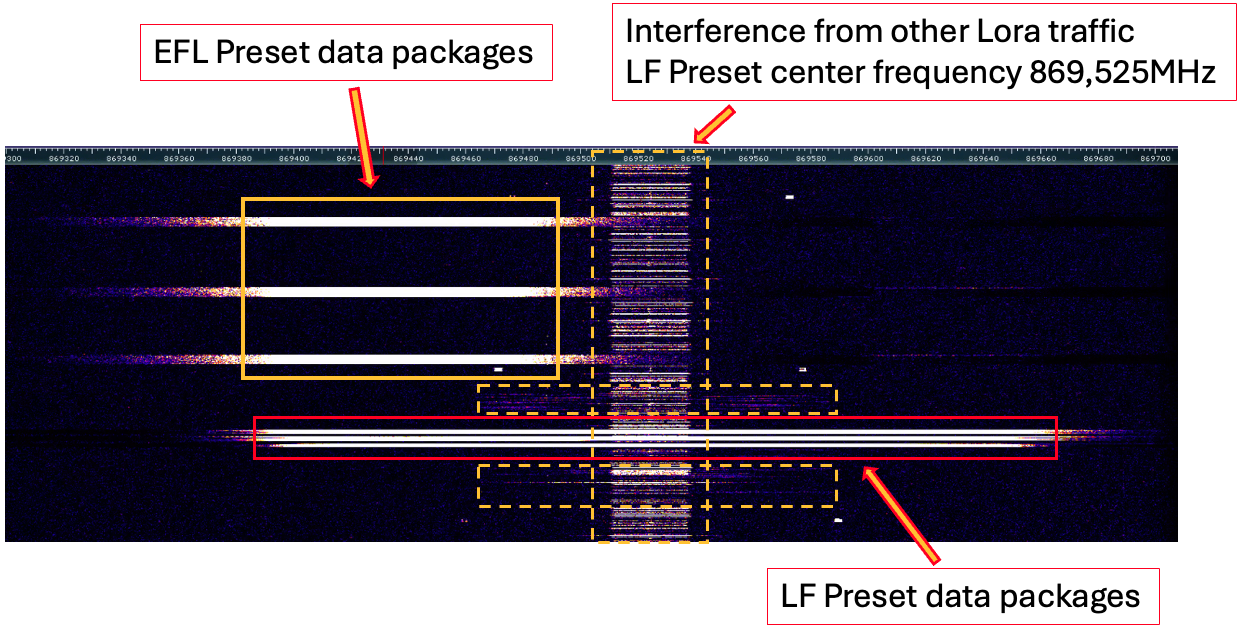
Illustrative spectrum view of LF and EFL LoRa traffic
This image is a conceptual, illustrative visualization of how LF and EFL data packets may appear and relate to other LoRa traffic within the same frequency range. It is not a precise measurement or an exact representation of on-air behavior, but a simplified depiction intended to help explain relative bandwidth usage, packet placement, and potential interference between different presets. Actual signal characteristics may vary depending on configuration, environment, and network activity.
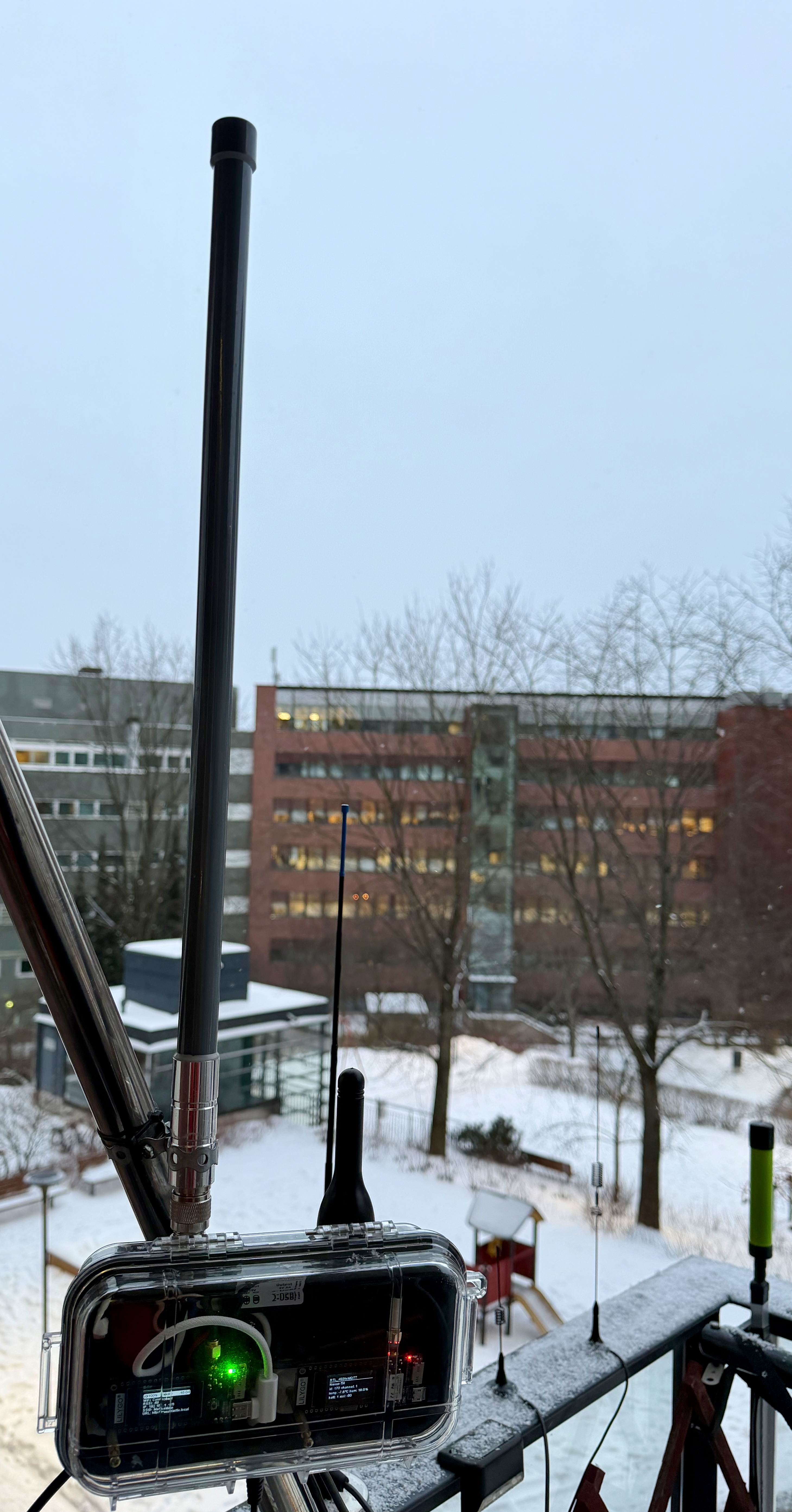
Current installation (EFL node):
On the left, LilyGo Meshtastic node.
On the right LilyGo 433 receiver (for weather stations).