Radio Blacksmith Knoll – Building a Radio Dream
From a single summer night impulse, a shortwave station was born that brought the legendary 6120 kHz frequency back to life, a frequency many had already forgotten. When amateur radio equipment transformed into a shortwave broadcast station and an Icom radio went on air, a project began that blends technical curiosity, respect for radio history, and the pure joy of hands-on experimentation. One hundred years of public broadcasting finds a continuation here, not through state institutions, but through a small yet audible hobbyist voice.
A Summer Night Idea
The story of Radio Blacksmith Knoll began with an unexpected spark, not a carefully planned project. Starting as a supporting content producer at RealMix Radio early in the year, and the sudden reappearance of a long-dormant childhood dream profession in hobby form, created a growing desire to do more.
On a warm summer night, a thought emerged: could the old shortwave frequency 6120 kHz, once used by the Finnish Broadcasting Company, be brought back to life by a single radio hobbyist? Could this frequency, which had carried the “Voice of the Nation” for nearly a century, be repurposed for hobbyist broadcasting?
The frequency choice was no coincidence. Radio broadcasting in Pori began in March 1925, featuring a string quartet performance and a lecture on radio technology. These broadcasts were produced by the Pori Radio Association.
Finnish Broadcasting Company (Yleisradio) was founded in 1926, after which local radio operations gradually consolidated under its umbrella. Later, the now state-owned broadcaster strengthened its presence in the Pori region by building a shortwave station on the grounds of Koivisto Manor in the late 1930s, intended for the Helsinki Olympic broadcasts.
Now, that frequency was requested for use once again, as a symbolic gesture and an experimental project.
The radio license application was submitted partly in jest, partly as a sincere experiment. When Traficom granted the permit, the idea quickly became reality. The first test broadcast went on air on July 1st, 2024, entirely manually operated. The programme was pre-recorded and transmitted using an Icom IC-7300 amateur radio transceiver, without any audio pre-processing, simply played out as an MP3 file.
At that point, there was little understanding of what a proper AM broadcast station truly requires. In hindsight, it is easy to admit that the poor Icom could only deliver a fraction of what the license allowed and what broadcast standards would support. Fortunately, the IC-7300’s audio bandwidth was limited to just under 3 kHz, which also meant that no licensing conditions were accidentally violated by transmitting overly wide audio.
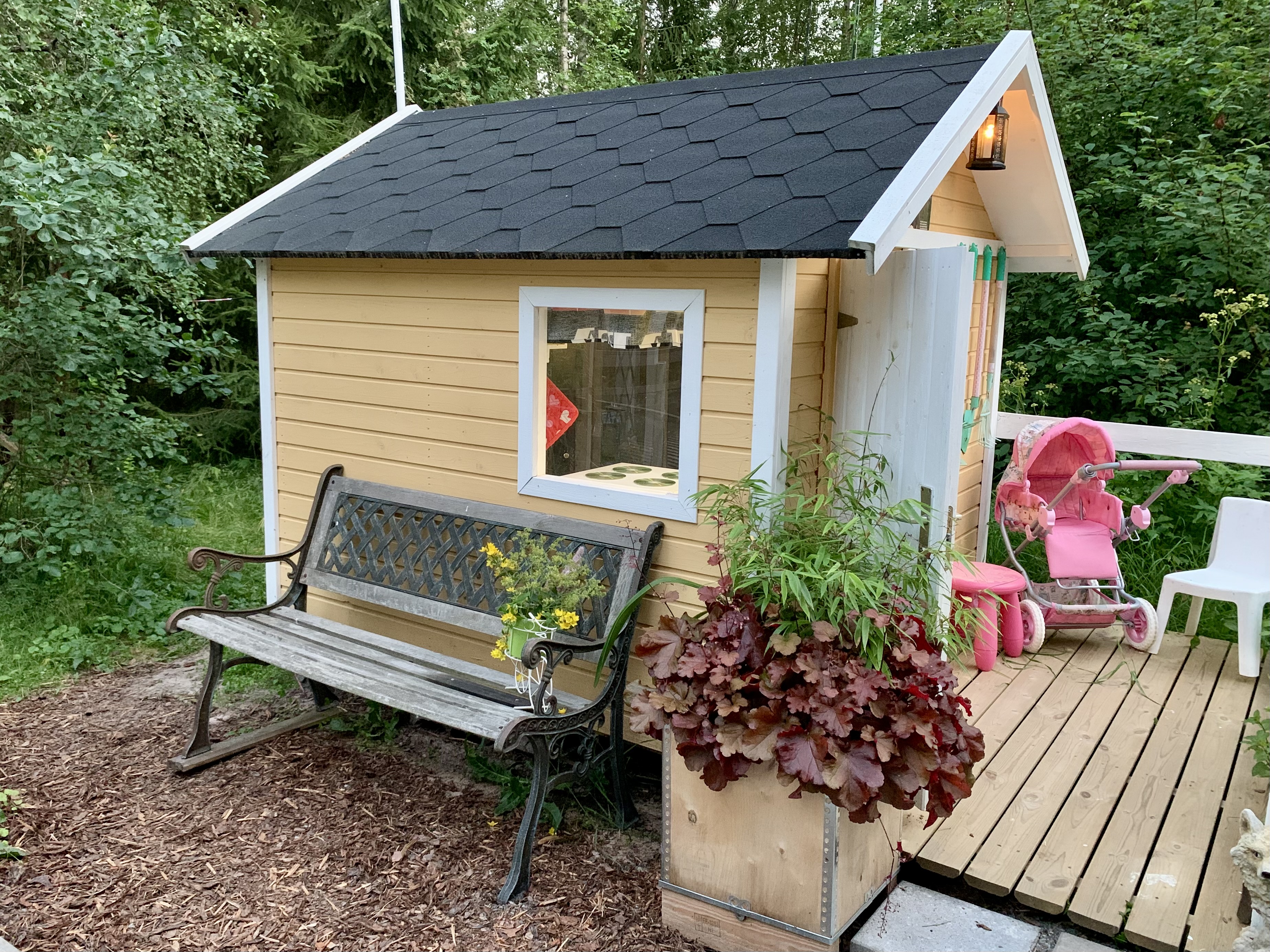
The station location became a small playhouse in a yard in Meri-Pori. It already housed a remotely operated amateur radio station, so RBSK was essentially an expansion of an existing setup. Inside the playhouse is an equipment rack containing everything needed for operation. The rack itself is disguised as a “wood stove,” and a computer monitor placed behind its glass front displays an HD fireplace video, adding warmth to the atmosphere, especially when children are visiting. The playhouse remains safe and is still actively used for play by godchildren.
The setup is far from a professional shortwave station, but the broadcasts worked. Listener feedback soon followed. Emails arrived from Finland and abroad, the most touching coming from a radio operator nearing one hundred years of age, who had listened to the “Pori station” during breaks in his work shifts in his youth.
At that point, it was no longer just an experiment. It had become a tribute to an era when radio was craftsmanship and every transmission was made with care.
Defining the Technology
After the first broadcast, it was clear that the project would continue. If the station was to stay alive, it needed a solid technical foundation, one that was tested in practice and developed gradually.
The antenna was the natural starting point. Weeks were spent on design, and a full week on construction, in heavy rain. Frequency tuning, SWR measurements, cable runs, and radiation pattern optimisation were all carried out carefully. The antenna was built twice, as the first version proved mechanically insufficient to withstand the forces of nature. The goal was not merely to get a signal on air, but to ensure it travelled where intended, in all weather conditions.
The Icom IC-7300 served well for the initial broadcasts but was never designed for continuous broadcast use. A wider audio bandwidth, more stable modulation, and proper audio pre-processing were needed. As a result, a genuine broadcast-grade AM transmitter was ordered from 9G Communications in the UK.
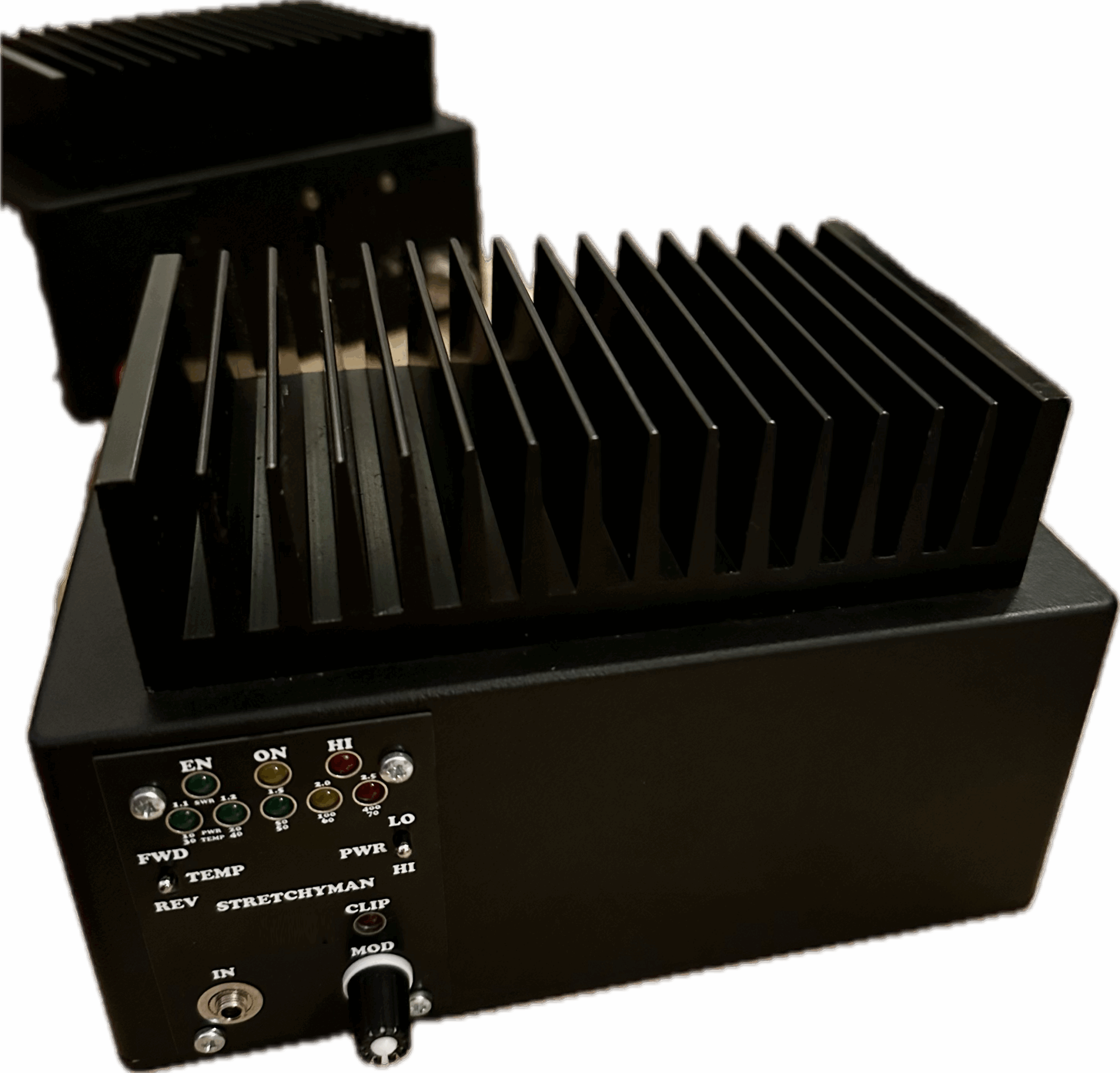
The new transmitter introduced new challenges: would the 500 VA isolation transformer feeding the playhouse be sufficient? Would a UPS be required to smooth peak loads? How should heat management and remote monitoring be handled?
The software side was ultimately built entirely in-house. While ready-made solutions exist, they are often prohibitively expensive. The studio environment is based on Apple computers, making Windows-based solutions unsuitable. Fortunately, macOS lends itself well to script-based automation, much like Linux. This resulted in a locally running, browser-based control interface for managing playlists, schedules, station IDs, and jingles. Everything runs automatically, while still allowing manual control, a crucial factor for reliable remote operation.
Content Is Created When Life Allows
Technology enables broadcasting, but content gives it meaning. RBSK was never intended to be filled with random playlists, but with original programming. In practice, and due to time constraints, an automated jukebox approach proved to be the only solution that ensured optimal use of airtime even when the station crew was fully occupied with everyday life.
The core scripted content was intentionally kept simple. This led to the monthly programme series “What Happened Today…”, which explores historical events, typically broadcast on the first Saturday of each month. Additional concepts under consideration include “Seen on TV” and experiments with classic series such as CBS Radio Mystery Theater.
Editorial note: The content and programming have evolved since this post and are now quite different from the original plans.
Producing programmes requires research, writing, recording, and mixing. This happens in the midst of daily life, whenever inspiration strikes and time allows. Each episode is a handcrafted piece, rough around the edges, home-built, yet faithful to its inspirations.
When the station plays only music, thematic programming was introduced from the very beginning. Instead of a generic mix, listeners might hear an entire weekend dedicated to unconventional styles or forgotten B-sides. Current events and their musical contexts also became themes, such as “RBSK Goes Synth!”, inspired by Jean-Michel Jarre’s June concert in Helsinki.
When Everything Breaks (Without Warning)
Technology works, until it doesn’t. One night, the station’s scheduling system, which had run flawlessly for weeks, simply stopped. It did not crash. It went silent. Programmes failed to start, station IDs were not played, yet outwardly everything appeared normal.
Troubleshooting required a deep dive into the automation logic. Scripts were reviewed line by line, the software logic dismantled and rebuilt. As the station operates remotely, all of this was done via remote connections, carefully and patiently, double-checking every step to ensure the station would not be rendered permanently silent.
The experience reinforced one key lesson: nothing is ever truly finished, and every failure is an opportunity to improve.
Building a Station – Easier Than You Think?
Building a shortwave station sounds like a massive undertaking, and partly it is, but it is not impossible. At a minimum, you need an antenna, a transmitter, a power supply, and an audio source. Remote locations add travel costs and the need for remote management solutions.
Programme content is self-produced. The largest recurring expenses are related to responsible operation: copyright fees, licenses, and the radio permit. The radio license itself is inexpensive, roughly six euros per month.
The basic technical setup can be built for around €1,500, and even less if suitable antenna materials are already available.
For RBSK, the shopping list included, in addition to the transmitter: sturdy nylon rope, cable ties, electrical tape, snap hooks, grounding rods, grounding copper, pulleys, thin plastic-coated steel wire, and four eight-metre fiberglass fishing rods. The antenna elements themselves consisted of 15 metres of 2.5 mm² MMJ cable, 50 metres of coaxial cable, a handful of connectors, and a 1:1 balun.
And of course, plenty of time.
Societal Relevance in a Changing World
Radio Blacksmith Knoll is a hobby project, but it also carries a broader perspective. Modern communication relies heavily on the internet and digital infrastructure. It is efficient, but vulnerable.
Crisis situations, storms, power outages, or cyberattacks can bring networks to a halt in an instant. In such moments, a small shortwave station and a battery-powered radio can become surprisingly important.
The war in Ukraine and numerous natural disasters have shown how individual hobbyists can maintain communication when other channels fall silent. A battery-powered transmitter, the necessary skills, and preparedness can form a critical bridge to the outside world.
Radio amateurs and independent stations form a quiet resilience network. They do not seek attention, but they are present when their voices are needed.
Shortwave is not merely an echo of the past. It remains a living and distinctive means of communication even today.
Facts About Radio Blacksmith Knoll (Summer 2025)
Station name: Radio Blacksmith Knoll (RBSK6120)
Frequency: 6120 kHz AM
Transmitter: 100W AM transmitter, 10 kHz bandwidth, pre-processed
Antenna: Half-wave dipole tuned to 6120 kHz (SWR 1.12), sloper 8/6 m toward the west
Power: Mains power, house battery UPS, remote monitoring and control
Remote control system: Home Assistant–based remote management
Programme delivery: In-house production, primarily CGI scripts, browser-based control UI, OS-level command-line tools
Audio processing: “Studio” Apple MacBook, StereoTool pre-processing, MP3 stream to a Raspberry Pi–based stream receiver, audio cable to transmitter
Want Your Own Shortwave Station? Consider These 8 Points
Choose a frequency – Check availability and apply for a license.
Decide on a format – Music stream or scripted programming?
Design the antenna – Precise tuning, directionality, minimal losses.
Choose a transmitter – Strong recommendation: 9G Communications
Power matters – Sufficient capacity, stability, UPS?
Invest in audio – With pre-processing, AM can sound excellent.
Automate – Scheduling systems simplify daily operation.
Pay what is due – Fair licensing, responsible operation. Running costs approx. €80/month.
Finally
Ask for help and advice. At the time of writing, Finland has three licensed hobby-based stations and SLART Ry, an association founded to support the establishment of new stations. They are happy to help with any questions you may have.
Text: Marco Johansson – MAC
Radio Blacksmith Knoll / SDXL – Radiomaailma 4/2025